
Male Carpenter Bee
Note the white patch on his face.
White patch, male - no white patch, female.

Bumblebee
This little guy was so active, I only got one photo.
.jpg)
Blue and Greenbottle Flies are as effective as bees at pollinating,
but they're usually thought of as feeding on filth,
and sometimes passing on diseases.
.jpg)
They're quite pretty. This one is feeding on nectar.

.jpg)
Lovely Honey Bee
.jpg)
Last year... a few Honey Bees, this year... many Honey Bees.
.jpg)
I'm wondering where their hive is.
.jpg)
Visiting at the mud hole for minerals and salts.

.jpg)
Lovely iridescent Crane Fly feeds on nectar and aphid honeydew.
Larvae live in leaf litter, moist soil and rotting logs.

.jpg)
East side of rain garden

South side of rain garden

Further down south side
.jpg)
Spicebush (Lindera benzoin) berries

.jpg)
Spicebushes in pots around deck

Hover Fly
Palpada furcata, a species of syrphid fly,
resting and sunning on Spicebush leaf.
Hover Flies are almost as effective as ladybugs and lacewings
at controlling aphids.
.jpg)
'Halcyon' Hosta (non-native)
Flowers hug the plant

Brown Eyed Susan (Rudbeckia triloba)
Easily grows to five feet tall.
Moved into the garden on its own.
.jpg)

Clematis pitcheri
Fairly heat and drought tolerant

'Hello Yellow' Blackberry Lily (non-native and non-invasive in this yard)
Actually related to Iris, not Lilies.
.jpg)
Liatris aspera, Blazing Star
Growing in pots with Late Purple Aster, Symphyotrichum patens


At my age, changes may come in small
differences in my life. A small
crossbody purse to replace an organizer purse twice its size, causing me to
drastically downsize that which I feel is essential to carry around with
me. A nothing event to others, but a significant
happening in finally admitting to myself that the organizer bag was beginning to feel like a fully packed suitcase hanging
from my shoulder.
Ideally, my garden rooms weave a
tapestry of adjectives and adverbs that are a self-portrait of me, but I've been slowing down as the years pass by, and the changes I make to my garden lately are a reflection of my health, not of my spirit. As I walk my backyard pathways today, then sit on the front porch to
look out over my front yard filled with trees, I question how these changes cause me to feel. Like that little crossbody bag, I have exchanged more for less to keep my quality of life in a good place. I'm a little bit sad about the loss.
I’m a wild person at heart, and that wildness is diminishing with age
while my garden’s wildness has compounded as it matures. My garden keeps reinventing itself, while I
myself have run out of reinventing. I
think the only way my old garden will ever meet it's demise, is perhaps at the hands of a new owner. Humans often have an irresistible desire to change
that which they didn’t create to that which they will create. Come to think of it, isn't that how I approached this yard in the beginning?
I believe my garden has left me in the dust as
nature seems to be a powerful force in reclaiming her. Sometimes I wish she would just vanish off
the face of the earth, but then I am reminded I created her at her beginning, and she depends on me for care to keep her safe and healthy. She’s like a child in the household, a very demanding
one at that, but still a child that can please only as heaven can when she is
happy.
While June and July were the months of dryness
and unforgiving heat, August comes in with a heart of compassion. The crackling of thunder can be heard almost
every late morning as the heat brings in the thunderstorms. Usually, a bit of fleeting coolness
accompanies the storms as they pass over.
If one storm skirts us and we miss the rain, another is sure to follow
with a downpour. Hopefully the month
will remain generous with rainfall.

Just a note about our calico, Lacey… besides
her medication for hyperthyroidism, she is now on medication for Crohn’s Disease,
plus temporarily, nausea medication. She
appears to be feeling better, and goes in for her two week check up on Friday.
(Well... I thought Lacey was getting better, but her check up showed she lost more weight, so her medication was changed. It's a living hell trying to find something she will eat.)
If anyone has been following Charlotte’s
saga of Lacey bullying her; after seven years, Charlotte has now left the
confines of my studio, and is adjusting to her freedom to go wherever she
chooses in the house. It’s been a tiring
experience working with Lacey, teaching her tolerance. Sometimes miracles do happen.

Native Bush Honeysuckle, Diervilla lonicera
Ours grows in clay soil, and is not as aggressive as ones grown in amended soil.
.jpg)
Leaf-footed Bug Nymph, Acanthocephala
The adult will have wings and a slightly different shaped body.
Both eat plants. I leave them alone.

Difficult taking photos of this little guy whose body (without the legs)
is about one inch long.
Wherever I moved it would start walking fast towards me.
.jpg)
It followed me to the eagle, climbed the eagle when I moved away,
then jumped from the top to the ground to follow me again.
It climbed the eagle a second time when I moved away,
then on into the shrub beyond.

Hairy Wild Petunia, Ruellia humilis
.jpg)
.jpg)
Tiny Green Crab Spider, Misumessus oblongus
on Rudbeckia 'Goldsturm'

This spider is capable of moving sideways or backwards without turning around.
.jpg)
On the pathway, it looked like a small green dot in the center of the flower.
.jpg)
Raised vegetable beds removed.
I'm not sure what to do with this area after we moved the stray potted plants in.
.jpg)
The saga of the missing stone cast squirrel
.jpg)
Disappeared some twenty years ago.
.jpg)
Itea virginica 'Saturnalia' shrub
spreads by runners and swallowed him up whole.
Last summer the Itea shrub was pruned back to make it easier to take care of the area surrounding the White Ash Tree.

This summer, the green side was above ground... the rest buried.
I thought it was a curious rock.
Brushing the dirt away with my fingers, I realized it wasn't.
A spade was needed to loosen the death grip of feeder roots around him.
.jpg)
He's a lot worse for wear.
He has stress cracks from freezing and thawing for twenty some years.
He'll have a nice home until he begins to crumble.
Lucky guy - poor guy... depends on how you look at it.
.jpg)
Maybe... Dun Skipper Butterfly, Euphyes vestris
on Joe Pye Weed, Eutrochium maculatum
.jpg)
1/4th inch long Robber Fly (Holcocephala fusca) with its huge compound eyes,
waiting on grass flower stem for lunch to fly by.
It's capable of catching insects in mid air.
It's considered beneficial, although it may dine indiscriminately
on other beneficial insects.
It kept moving to the other side of stem as I photographed.

Female Cabbage White Butterfly, Pieris rapae
on Hairy Sunflower, Helianthus hirsutus
.jpg)


Oenothera gaura, or Biennial Beeblossom

These appeared in the garden on their own, perhaps five years ago.
They grow up to six feet tall. We use plant supports to keep them more upright,
although they do fine sprawled out in wilder areas.

They have an airy, ethereal appearance in the landscape.
Here they mingle with the tall blossoms of
'Challenger' and 'Autumn Minaret' Daylilies.
.jpg)
Augochlora pura, little pure gold-green solitary sweat bee
with ants on Butterfly Weed.
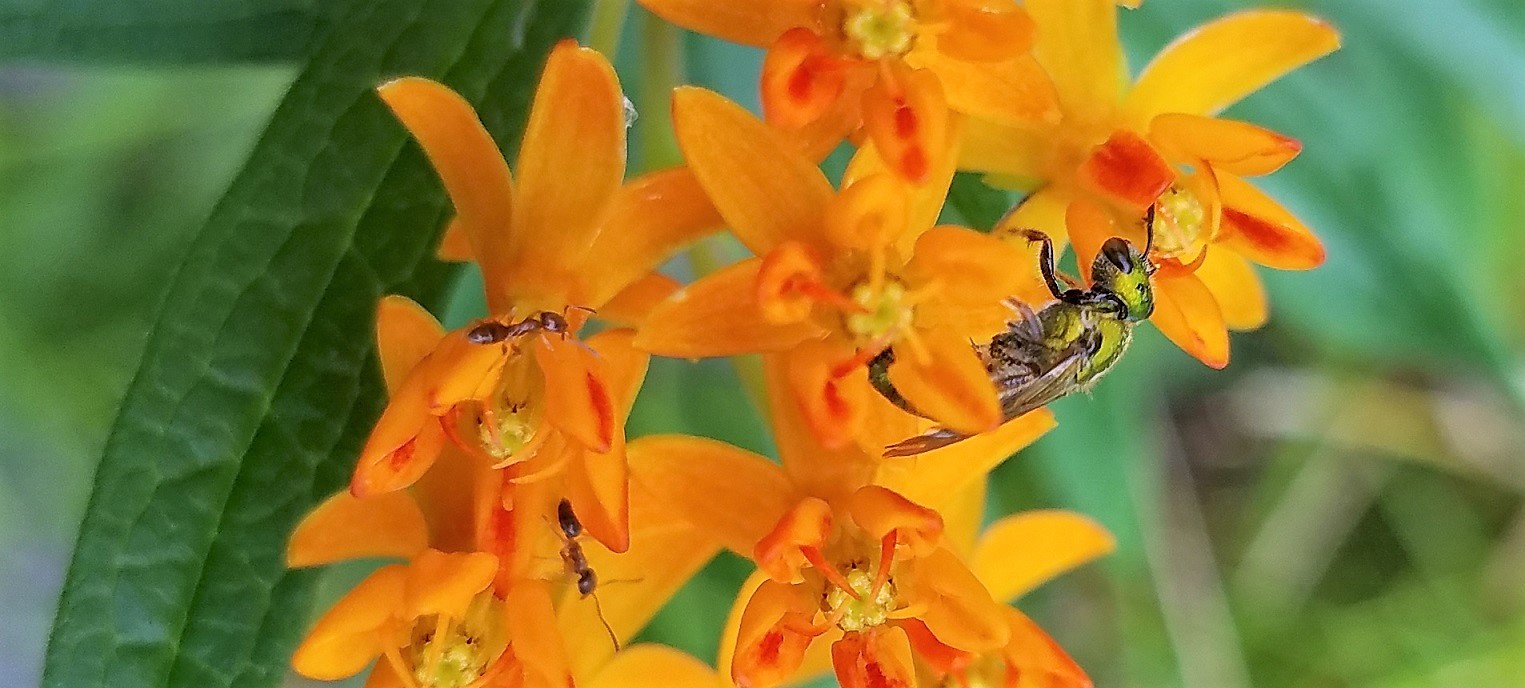
Regular milkweed has toxins to deter ants,
but Butterfly Weed's toxins are weaker
and apparently do not repel ants.


Dolichopodidae, a family of Long-Legged Flies (True Flies)
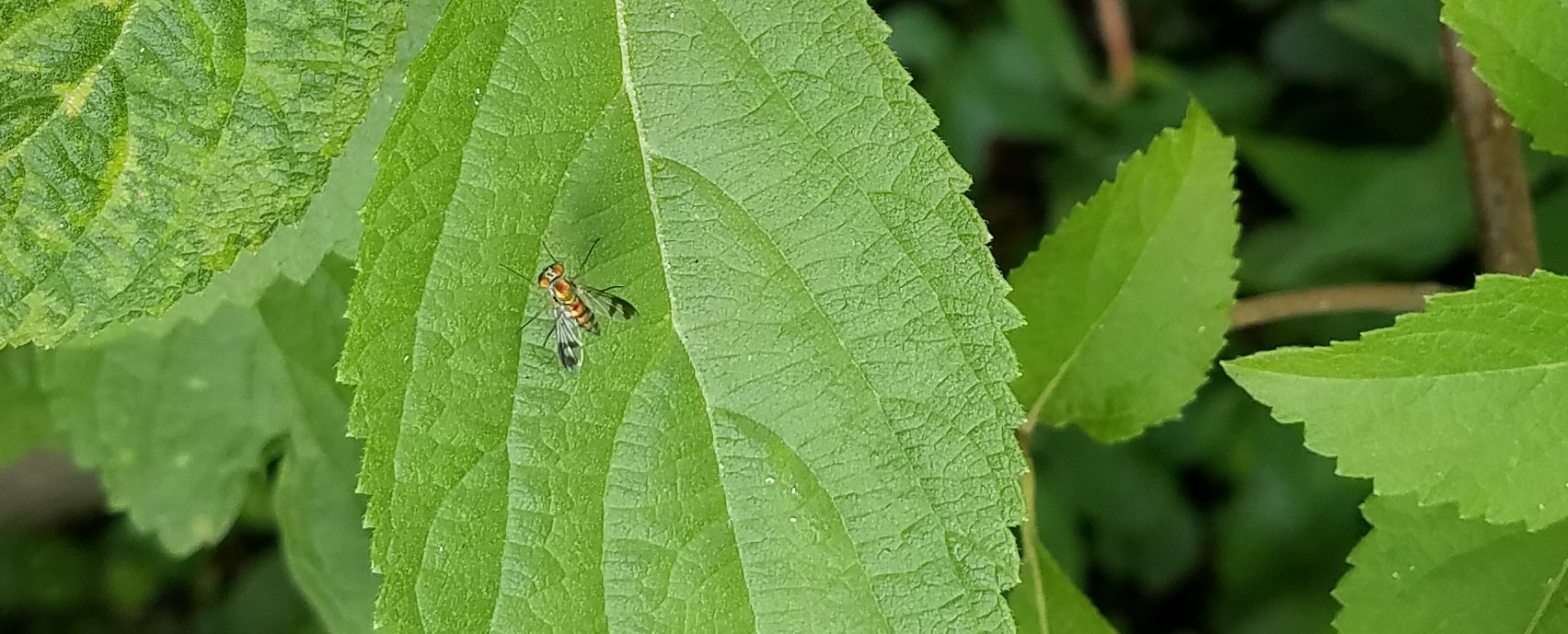
Their beauty is missed until viewed close up.

.jpg)
“However many years she lived,
Mary always felt that 'she should never forget that first morning
when her garden began to grow'.”
This Post is Linked To:

